


 Casa /
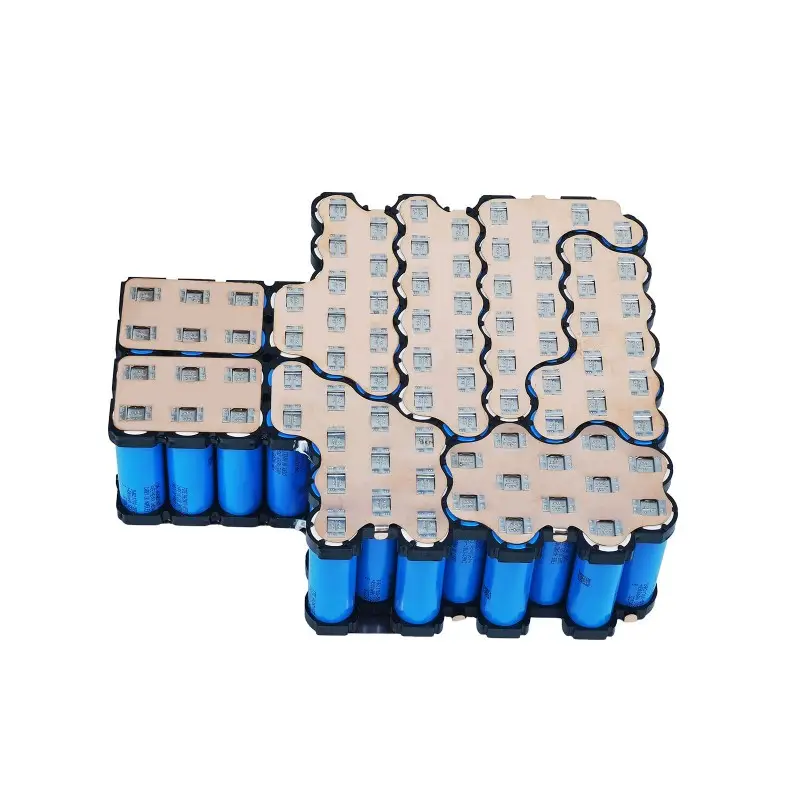
 Pacote de baterias personalizadas de íon-lítio 21700 de 51,8V 30Ah para sistemas comerciais de energia robótica humanoide com BMS embutido para operação segura e confiável


Índice
- Why Humanoid Robots Need a Custom Battery System
- 51.8V 30Ah Configuration for Stable System Power
- Advantages of High-Energy-Density 21700 Cells
- Built-In BMS for Protection and Monitoring
- Mechanical and Thermal Design for Moving Robots
- Applications in Commercial Humanoid Robotics
- Information Required for Battery Customization
- Quality Control for Reliable Robot Operation
- Conclusão
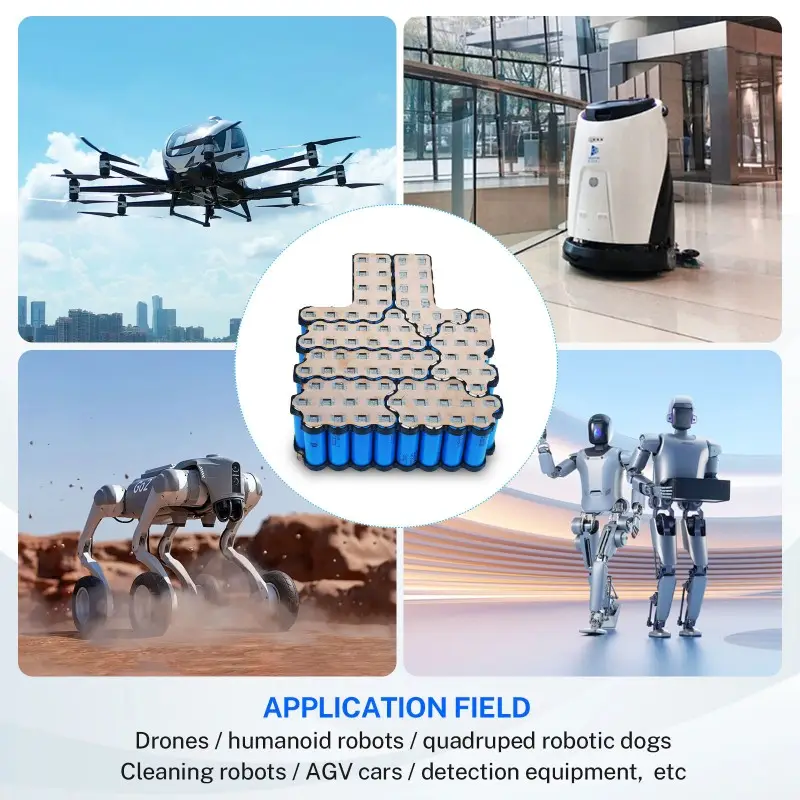
Commercial humanoid robots place unusual demands on their power systems. Unlike a stationary machine with a stable electrical load, a humanoid robot must continuously support joint motors, balance control, sensors, onboard computing, communication equipment, cameras, and interactive functions. Its power demand can change quickly as it walks, lifts an object, turns, climbs a slope, or recovers its balance.
A custom 51.8V 30Ah lithium-ion battery pack built with 21700 cells provides a practical power solution for these demanding robotic platforms. With approximately 1.55 kWh of nominal energy, the pack can be engineered to deliver stable output, sufficient operating time, and reliable protection within the limited installation space of a commercial humanoid robot.
Why Humanoid Robots Need a Custom Battery System
Selecting a humanoid robot battery involves much more than matching voltage and capacity. The battery must fit the robot’s internal structure, maintain a suitable center of gravity, withstand repeated movement, and deliver short bursts of higher current without causing an unexpected shutdown.
A standard battery may have the correct electrical rating but still be unsuitable because of its dimensions, connector position, discharge capability, communication protocol, or mounting method. Humanoid robots often have narrow internal compartments, complex wiring routes, and strict weight-distribution requirements.
A custom battery pack allows the enclosure shape, cable direction, terminals, communication ports, mounting points, and protection settings to be developed around the robot itself. This improves mechanical integration and reduces the need to redesign the robot around an existing battery.
51.8V 30Ah Configuration for Stable System Power
The 51.8V nominal voltage is suitable for robotic systems that require efficient power delivery to multiple motors and electronic subsystems. A higher system voltage can help reduce operating current for the same power level, although the battery must always match the motor drivers, power distribution unit, controller, and charger.
The 30Ah capacity offers a balance between runtime, pack size, and total weight. Actual operating time depends on many factors, including robot weight, walking speed, number of active joints, payload, terrain, computing demand, standby time, and environmental temperature.
For example, a reception robot standing and interacting with visitors may consume less energy than a humanoid robot performing repeated walking and handling tasks. Battery capacity should therefore be selected from measured average and peak power consumption rather than estimated from voltage and ampere-hours alone.
Advantages of High-Energy-Density 21700 Cells
The 21700 cylindrical cell format is widely considered for advanced robotic battery packs because it can provide strong energy density and discharge performance in a relatively compact structure.
Compared with smaller cylindrical formats, 21700 cells may help reduce the total number of cells and electrical connections required for a given pack capacity. This can simplify module construction while supporting efficient use of the available installation space.
However, cell format alone does not determine battery quality. Cell consistency, internal resistance, capacity matching, welding quality, insulation, thermal design, and pack structure all influence final performance. Cells should be selected according to the robot’s continuous current, peak current, operating temperature, charging requirements, and expected service life.
Built-In BMS for Protection and Monitoring
A built-in battery management system is essential for a commercial humanoid robot battery. It monitors the condition of individual cell groups and the complete battery pack during charging, discharging, and standby operation.
Depending on the customized design, BMS functions may include:
- Overcharge and over-discharge protection
- Overcurrent and short-circuit protection
- High- and low-temperature protection
- Cell-voltage monitoring and balancing
- Pack current and temperature monitoring
- State-of-charge estimation
- Fault reporting and event recording
Communication interfaces such as CAN, RS485, RS232, or UART can also be integrated. Through communication with the robot controller, the battery can provide information about voltage, current, temperature, remaining energy, charging status, and fault conditions.
This data allows the robot to make better operational decisions. It can reduce nonessential functions, return to a charging station, issue a maintenance warning, or shut down safely before the battery reaches a critical condition.
Mechanical and Thermal Design for Moving Robots
Humanoid robots generate constant vibration and movement. Their batteries may experience acceleration, braking, joint motion, impact, and changes in orientation. The pack must therefore be secured with a reliable mounting structure and protected against internal cell movement.
The enclosure can be customized in metal or engineered plastic, depending on weight, strength, heat dissipation, and environmental requirements. Internal insulation, cell holders, buffering materials, wiring protection, and connector locking structures should be considered during development.
Thermal design is equally important. Heat can be generated by both the cells and the BMS during high-current operation. The battery compartment should provide suitable heat transfer without exposing the pack to moisture, dust, or mechanical damage.
For robots operating in cold conditions, optional low-temperature charging protection or heating functions may be required. Temperature sensors should be positioned according to the actual cell arrangement rather than placed only near the BMS.
Applications in Commercial Humanoid Robotics
A 51.8V 30Ah robot battery pack can support various commercial humanoid platforms. Reception robots may use it to power displays, voice interaction systems, cameras, sensors, and movement functions in hotels, offices, exhibitions, and shopping centers.
Delivery and assistance robots require reliable energy for navigation, load handling, communication, and repeated movement. Security robots need stable power for patrol routes, cameras, environmental sensors, and wireless data transmission.
Industrial humanoid robots may perform inspection, material transfer, assembly assistance, tool handling, or repetitive support tasks. These applications often create higher peak-current demands and more vibration than light commercial service environments.
The battery can also be customized for research institutions and robotics developers building prototype humanoid platforms.
Information Required for Battery Customization
Before developing the pack, the battery manufacturer should receive detailed information about the robot, including:
- Nominal and maximum system voltage
- Average, continuous, and peak current
- Tempo de operação necessário
- Maximum battery dimensions and weight
- Requisitos de conectores e cabos
- Charging voltage, current, and method
- BMS communication protocol
- Operating and storage temperatures
- Installation orientation and mounting points
- Required environmental protection
Providing load curves, mechanical drawings, connector photographs, and charger specifications can shorten development time and reduce unnecessary prototype revisions.
Quality Control for Reliable Robot Operation
Battery reliability begins with incoming-material inspection and cell matching. During assembly, welding strength, insulation, wire routing, BMS connection, connector installation, and enclosure fastening should be carefully controlled.
Finished packs should be tested for voltage, capacity, internal resistance, charge and discharge performance, protection functions, communication, temperature monitoring, insulation, and connection reliability. Application-specific vibration, impact, aging, or thermal testing may also be needed.
Conclusão
A custom 51.8V 30Ah 21700 lithium-ion battery pack is not simply an energy container for a humanoid robot. It is an integrated part of the robot’s movement, control, communication, charging, and safety systems.
By matching the cells, BMS, enclosure, connectors, discharge capability, and communication functions to the actual robot design, manufacturers can achieve more stable performance, predictable runtime, and safer daily operation.
Converse com o Fabricante
Recursos e Insights
Melhor Bateria LiPo para Dispositivos IoT: Como Escolher a Solução Certa de Energia
2026-07-28
Pacote de baterias personalizadas de íon-lítio 21700 de 51,8V 30Ah para sistemas comerciais de energia robótica humanoide com BMS embutido para operação segura e confiável
2026-07-28
Módulo de bateria LiFePO4 Custom 38.4V 30Ah para robôs com porta de carregamento sem fio
2026-07-28
24V 36V 48V 52V 60V 72V 40Ah 50Ah LiFePO4 Recarregável para RVs, AGVs, carrinhos de golfe e sistemas de armazenamento de energia
2026-07-28


