


 Casa /
 Bateria de Íon-Lítio 24V 10Ah–13Ah 7S5P 18650 para Iluminação Solar


Índice
- Understanding the 7S5P Battery Configuration
- Why 18650 Lithium-Ion Cells Are Used
- Stable Energy Supply for Nighttime Lighting
- Proteção Integrada do BMS
- Matching the Battery with the Solar Controller
- Customization for Different Solar Lighting Projects
- Áreas de Aplicação Típicas
- Conclusão
- Perguntas Frequentes
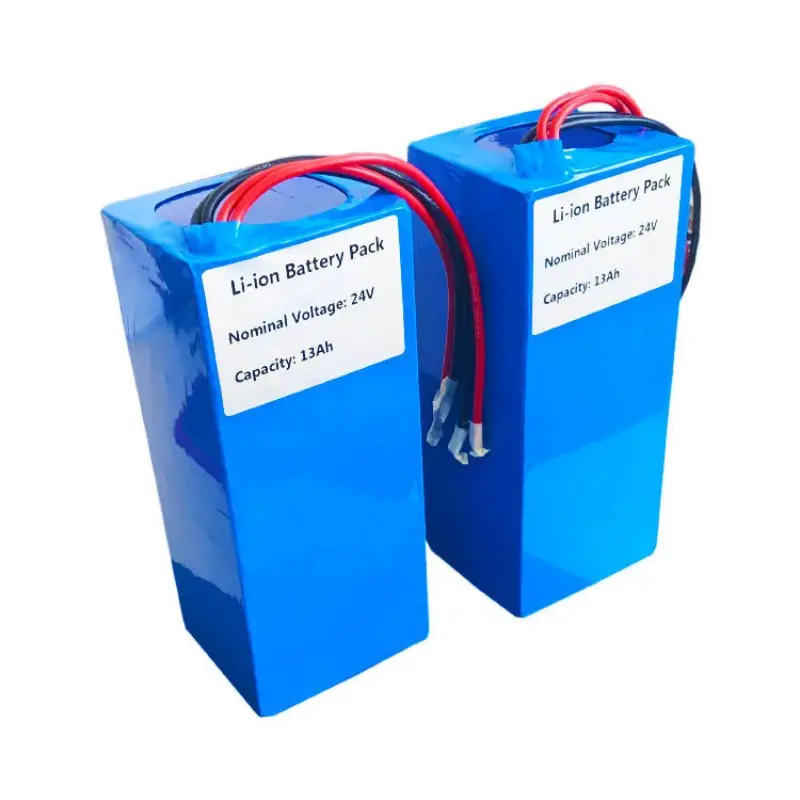
A reliable battery is essential to the performance of any solar street lighting system. The solar panel may collect energy during the day, but the battery determines whether the LED lamp can operate steadily throughout the night. Poor battery selection can result in reduced lighting time, unstable brightness, frequent protection shutdowns, and premature system maintenance.
The 24V 10Ah–13Ah 7S5P 18650 lithium-ion battery pack is designed for solar street lights and outdoor LED lighting systems that require compact size, high energy density, and dependable rechargeable performance. Built with 35 cylindrical 18650 cells, the pack uses seven cell groups in series and five cells in parallel. This arrangement provides a practical balance between voltage, capacity, physical dimensions, and operating time.
Technically, a standard 7S lithium-ion battery pack has a nominal voltage of approximately 25.2V and is commonly described as a 24V-class battery. Its full charging voltage is normally 29.4V, depending on the selected cells and charging system. For safe and efficient operation, the solar charge controller and LED driver must be compatible with the battery’s actual voltage range.
Understanding the 7S5P Battery Configuration
The term 7S5P describes how the individual 18650 cells are connected inside the battery pack.
“7S” means seven cell groups are connected in series. Series connection increases the total voltage while maintaining the capacity of one parallel group. “5P” means five cells are connected in parallel within each group. Parallel connection increases the available capacity and current capability.
A complete 7S5P battery pack therefore contains 35 cells. Depending on the capacity of each selected 18650 cell, the finished pack can provide approximately 10Ah to 13Ah. For example, five 2,000mAh cells connected in parallel produce a 10Ah group, while five 2,600mAh cells produce a 13Ah group.
This structure is suitable for solar street lights because it offers enough stored energy for extended nighttime operation without requiring an excessively large or heavy battery enclosure.
Why 18650 Lithium-Ion Cells Are Used
18650 lithium-ion cells are widely used in rechargeable battery systems because they provide high energy density in a standardized cylindrical format. Their compact dimensions allow the cells to be arranged in different layouts to match the available installation space.
Compared with heavier traditional batteries, an 18650 lithium-ion battery pack can reduce overall system weight while storing a useful amount of energy. This is especially valuable for integrated solar street lights, pole-mounted battery boxes, and compact outdoor lighting systems.
The final battery performance depends heavily on cell quality and consistency. Cells used in the same pack should have closely matched capacity, internal resistance, and voltage characteristics. Proper cell matching helps reduce imbalance during repeated charging and discharging and supports more stable long-term performance.
Stable Energy Supply for Nighttime Lighting
Solar street lights normally charge during daylight hours and discharge gradually after sunset. Unlike high-power tools or electric vehicles, the battery usually supplies a moderate current over several hours.
A properly designed 24V 10Ah–13Ah battery pack can provide stable power for LED lamps, controllers, sensors, and other electronic components. The required battery capacity should be calculated according to the lamp power, operating time, controller efficiency, local sunlight conditions, and expected backup duration.
For example, a street light operating at reduced brightness during late-night hours may require less battery capacity than a lamp running at full output throughout the night. Intelligent dimming, motion sensing, and timed lighting modes can also help extend operating time.
Capacity should not be selected only according to one night of operation. Solar projects in areas with cloudy or rainy weather may need additional energy reserve to support one or more low-sunlight days.
Proteção Integrada do BMS
A battery management system is a critical part of a rechargeable lithium-ion battery pack. The BMS monitors the electrical condition of the pack and helps protect the cells from operating outside their safe limits.
Funções típicas de proteção incluem:
- Proteção contra sobrecarga
- Proteção contra sobredescarga
- Proteção contra sobrecorrente
- Proteção contra curto-circuito
- Proteção contra temperatura
- Balanceamento de células
Overcharge protection prevents the battery voltage from rising beyond the specified limit during solar charging. Over-discharge protection disconnects the load before the cells reach an excessively low voltage. Overcurrent and short-circuit protection help reduce the risk of damage caused by wiring faults or abnormal loads.
The BMS current rating must be selected according to the normal LED operating current and any temporary peak current. Using an undersized BMS may cause unwanted shutdowns, while an incorrectly configured protection board can reduce safety and reliability.
Matching the Battery with the Solar Controller
The battery, solar controller, panel, and LED load must work as one coordinated system. A controller designed for another battery chemistry or voltage range may not charge a 7S lithium-ion pack correctly.
For a typical 7S configuration, the charging system should support the battery’s required full-charge voltage and use suitable current limits. Low-voltage cut-off and recovery settings should also match the BMS and cell specifications.
The solar panel output must provide enough energy to recharge the battery during the available daylight period. An oversized battery paired with an undersized panel may remain partially charged for long periods, while an oversized panel without proper current control may place unnecessary stress on the battery.
Confirming these parameters before production helps prevent charging incompatibility and improves the overall service life of the lighting system.
Customization for Different Solar Lighting Projects
Solar street light structures vary widely. Some batteries are installed inside the lamp housing, while others are placed inside a pole, metal enclosure, underground box, or separate waterproof case.
The 24V 7S5P battery pack can be customized according to project requirements, including:
- Dimensões da bateria e arranjo das células
- 10Ah or 13Ah capacity
- PVC wrapping, plastic housing, or metal enclosure
- Tipo de conector e terminal
- Comprimento do cabo e bitola de fio
- Separate or shared charging and discharge ports
- Configurações de corrente e proteção do BMS
- Temperature sensor installation
- Waterproofing and insulation design
- Mounting brackets or fixing points
For outdoor installations, the enclosure should be designed to prevent water entry, condensation, dust accumulation, and cable damage. Heat dissipation should also be considered, particularly when the battery is installed inside a sealed housing exposed to direct sunlight.
Áreas de Aplicação Típicas
Although primarily designed for solar street lights, this battery pack can also be used in other rechargeable outdoor lighting systems, such as solar garden lights, pathway lighting, parking area lamps, security lights, landscape lighting, traffic warning equipment, billboard lighting, and remote off-grid LED systems.
It is suitable for integrated solar lamps, split-type solar street lights, smart lighting systems, and OEM products requiring a custom battery shape or connector.
Conclusão
The 24V 10Ah–13Ah 7S5P 18650 lithium-ion battery pack provides a compact and flexible energy storage solution for solar street lights. Its 35-cell configuration combines practical capacity, stable voltage output, and high energy density for daily solar charging and nighttime LED operation.
Reliable performance depends on more than battery capacity alone. Cell consistency, BMS settings, controller compatibility, enclosure design, charging current, discharge requirements, and environmental conditions must all be considered. A properly customized battery pack can improve lighting duration, system safety, installation efficiency, and long-term reliability.
Perguntas Frequentes
What is the nominal voltage of a 7S lithium-ion battery pack?
A 7S lithium-ion battery pack normally has a nominal voltage of approximately 25.2V and a full-charge voltage of 29.4V. It is commonly marketed as a 24V-class battery pack.
How many cells are used in a 7S5P battery pack?
A 7S5P battery pack contains 35 cells. Seven groups are connected in series, with five cells connected in parallel within each group.
Is a 10Ah or 13Ah battery better for a solar street light?
The correct capacity depends on LED power, operating hours, sunlight availability, dimming settings, and required backup time. A 13Ah pack stores more energy, but it may also require a larger enclosure and longer charging time.
Does the battery pack include BMS protection?
The pack can include an integrated BMS with overcharge, over-discharge, overcurrent, short-circuit, temperature, and cell-balancing protection. Protection settings should be matched to the solar controller and LED load.
Can the battery size and connector be customized?
Yes. The cell layout, battery dimensions, casing, connector, wire length, BMS rating, charging port, and discharge port can be customized according to the solar lighting system.
Converse com o Fabricante
Recursos e Insights
Fabricante de Design de Pacote de Bateria Personalizado: Do conceito da bateria à produção confiável
2026-07-30
Pacote recarregável de baterias de íon-lítio 12V 7800mAh 3S3P 18650 para semáforos
2026-07-30
Bateria de Íon-Lítio 24V 10Ah–13Ah 7S5P 18650 para Iluminação Solar
2026-07-30
Baterias LiFePO4 personalizadas com células 18650, 26650 ou 32700, 6,4V–12,8V, 6Ah–45Ah para iluminação LED e luminária solar
2026-07-30


